Introduction
If you’ve worked with trucks long enough, you already know this—battery problems never show up at a good time. It’s either early morning dispatch or mid-route, and suddenly the truck just won’t crank.
And when that happens, it’s not just a battery issue.
It’s a delay, a missed delivery, a pissed-off driver, and money lost.
Most people still treat truck batteries like they’re all the same. They’re not. The type you use makes a big difference, especially in Indian conditions where heat, load, and road conditions are not exactly forgiving.
In this blog by Metro Redx a Truck Battery Manufacturer in India, we explore just that.
Why truck batteries are a different game
A car battery failing is inconvenient.
A truck battery failing is a problem.
You’re dealing with:
- bigger engines
- longer hours
- rough roads
- constant vibration
- multiple electrical loads
On top of that, most trucks run a 24V system using two batteries. If even one battery weakens, the whole setup starts acting up.
That’s why you don’t just pick “any” battery. You pick what actually holds up in your type of work.
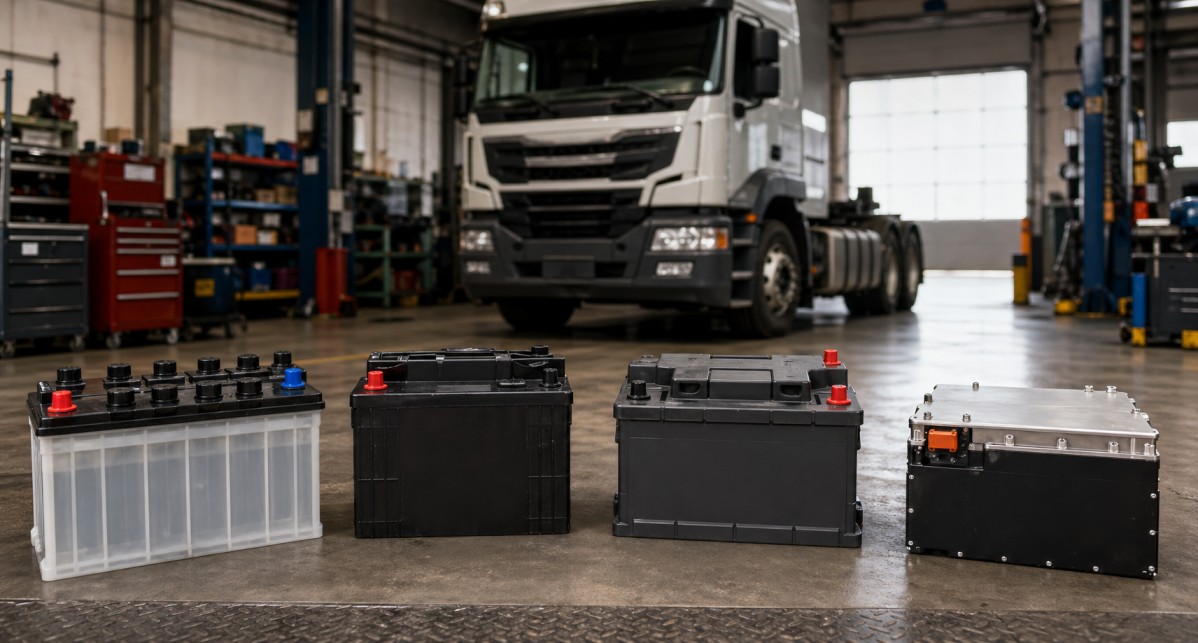
Flooded Lead-Acid Batteries
This is what most trucks still run on.
They work. No doubt. But they need attention.
If the driver is regular with maintenance, keeps water levels in check, and the truck runs daily, these batteries can do the job just fine.
But here’s what actually happens in real life:
maintenance gets skipped.
Then:
- water levels drop
- plates get exposed
- cranking weakens
And suddenly the truck struggles to start.
Where they make sense
- basic fleet setups
- trucks running daily routes
- when cost is the main concern
Where they struggle
- trucks sitting idle
- poor maintenance habits
- rough usage without checks
AGM Batteries
Now this is where things get more practical.
AGM batteries handle abuse better.
Less maintenance, better stability, and they don’t give up easily.
If you’ve got trucks doing city runs with constant stopping and starting, this is where AGM starts making more sense.
I’ve seen this myself—
a delivery truck doing 40–50 stops a day will drain a weak battery fast. AGM holds up better in that kind of work.
Where they work best
- city delivery trucks
- long-haul trucks with electrical load
- fleets that want fewer breakdown calls
What to expect
- better starting consistency
- less maintenance headache
- higher upfront cost, but fewer replacements
EFB Batteries
EFB is like the middle option that doesn’t get talked about enough.
It’s stronger than basic flooded batteries, but cheaper than AGM.
For fleets that don’t want to jump straight to AGM but still need better performance, this is usually the practical upgrade.
Real-world use
If your trucks are running regular routes—not too extreme, not too light—EFB fits well.
Where they make sense
- mid-level fleet operations
- predictable routes
- cost vs performance balance
Gel Batteries
Not very common, but useful in specific situations.
These are more stable when:
- the truck is sitting idle
- roads are rough
- battery position is not ideal
You’ll see these more in special-purpose vehicles than regular fleet trucks.
Where they work
- standby vehicles
- rough terrain
- low-usage trucks
Lithium Batteries
Everyone talks about lithium, but let’s be real—it’s not standard for most trucks yet.
Yes, it’s lighter.
Yes, it charges fast.
Yes, it lasts longer.
But:
- it’s expensive
- not always necessary
- not always practical for every fleet
Where it fits
- specialized applications
- high-end setups
- where long-term efficiency matters more than upfront cost
What actually matters in the real world
Forget technical terms for a second.
These are the things that actually decide whether your battery is good or not:
- Does it crank every morning without struggle?
- Does it handle repeated starts without weakening?
- Can it survive bad roads and vibration?
- Does it hold charge if the truck sits for a few days?
If the answer is no to any of these, the battery is going to give you trouble sooner or later.
Real situations you’ll recognize
Long-haul trucks
They need consistency. Once they’re on the road, the battery shouldn’t be the weak link. AGM usually works better here.
City delivery trucks
Start-stop all day. Weak batteries don’t last here. AGM or EFB is the safer choice.
Trucks on rough roads
Vibration kills batteries faster than people realize. Build quality matters more than specs here.
Trucks that sit idle
This is where most batteries fail quietly. If a truck doesn’t run for days, the battery needs strong charge retention.
What dealers should actually focus on
Instead of pushing whatever is in stock, ask:
- How is the truck used?
- Daily run or occasional?
- City or highway?
- Rough roads or smooth routes?
- Owner wants cheap or wants reliability?
That’s how you match the right battery.
Anything else is just guessing.
Where Metro Redx fits in
Metro Redx focuses on building batteries that deal with actual truck conditions, not ideal ones.
That means:
- handling vibration
- consistent cranking power
- reliability over time
- fewer unexpected failures
For dealers and fleet owners, that’s what matters.
A battery should not be something you keep worrying about.
It should just work.
That’s what you expect from a Truck Battery Manufacturer in India that understands real usage.
Conclusion
There is no “one best battery” for all trucks.
- Flooded batteries work if maintained properly
- EFB gives a balanced upgrade
- AGM handles heavy usage better
- Gel fits specific needs
- Lithium is still a niche option
The right choice depends on the work the truck is doing.
At the end of the day, no one cares about specs when the truck doesn’t start.
What matters is simple:
turn the key, and the engine starts. Every time.
Ensure you choose a reliable truck battery manufacturer in India such as Metro Redx for the best experience.